Tanabata and Qixi
How the world celebratesOne legend about a weaver and a herdsman, one date in the seventh lunar month, and three societies that made three different festivals out of it.
Quick answers
| Place | When is it? | How the date is set |
|---|---|---|
| United States | Not observed here | Not on the official list |
| Japan · 湘南ひらつか七夕まつり | July 2, 2027 – July 4, 2027 | Three days from the first Friday in July, fixed each year by the organising committee. |
| Japan · 七夕(たなばた) | July 7, 2027 | — |
| Japan · 仙台七夕まつり | August 6, 2027 – August 8, 2027 | — |
| China | August 8, 2027 | The seventh day of the seventh month of the Chinese lunisolar calendar. |
| Taiwan · 七夕 | August 8, 2027 | The seventh day of the seventh month of the Chinese lunisolar calendar. |
| Taiwan · 做十六歲 | August 8, 2027 | The seventh day of the seventh month of the Chinese lunisolar calendar, the birthday of the Seven Mothers. |
| Brazil | Not observed here | Not on the official list |
| Indonesia | Not observed here | Not on the official list |
| India | Not observed here | Not on the official list |
🗳️ What about you?
If a Tanabata- or Qixi-like day existed where you live, how would you spend it?
Live answers aren't available right now. Read the topic below.
Say what is wrong and what is correct — a source link helps.
Near you
Nothing here yet.
Events
Nothing here yet.
Now
People are talking about this
Live discussion isn't available right now
Read the topic and check back later.
How the world celebrates
- July 2, 2027– July 4, 2027Local date
How does Japan mark Tanabata and Qixi? · 湘南ひらつか七夕まつり
Hiratsuka in Kanagawa Prefecture supplies a third timing. The Shonan Hiratsuka Tanabata Festival runs in early July — neither the 7th nor August: the 74th edition ran 3 to 5 July 2026, a Friday to a Sunday, after the 73rd drew 1.15 million visitors over its three days. The city's press release of 23 April 2026 sets out the detail: eighty decorations along the Shonan Star Mall, twenty-six of them made by residents, seventeen more along Beniya Pearl Road, around a hundred large pieces in the shopping streets by the station; closing time on the first two days extended by thirty minutes to 8.30 p.m., and 7 p.m. on the last day; the thousand-strong Tanabata dance parade rerouted for heat safety, with a "Tanabata COOL" scheme asking shopfront traders to help keep visitors cool and mist fans installed along the decorated streets. The same release announces the following year in advance: 2 to 4 July 2027. Put the three side by side and the point is visible inside a single country — 7 July, 6–8 August, and the first weekend of July, and not one of them is the seventh day of the seventh lunar month.
- July 7, 2027Local date
How does Japan mark Tanabata and Qixi? · 七夕(たなばた)
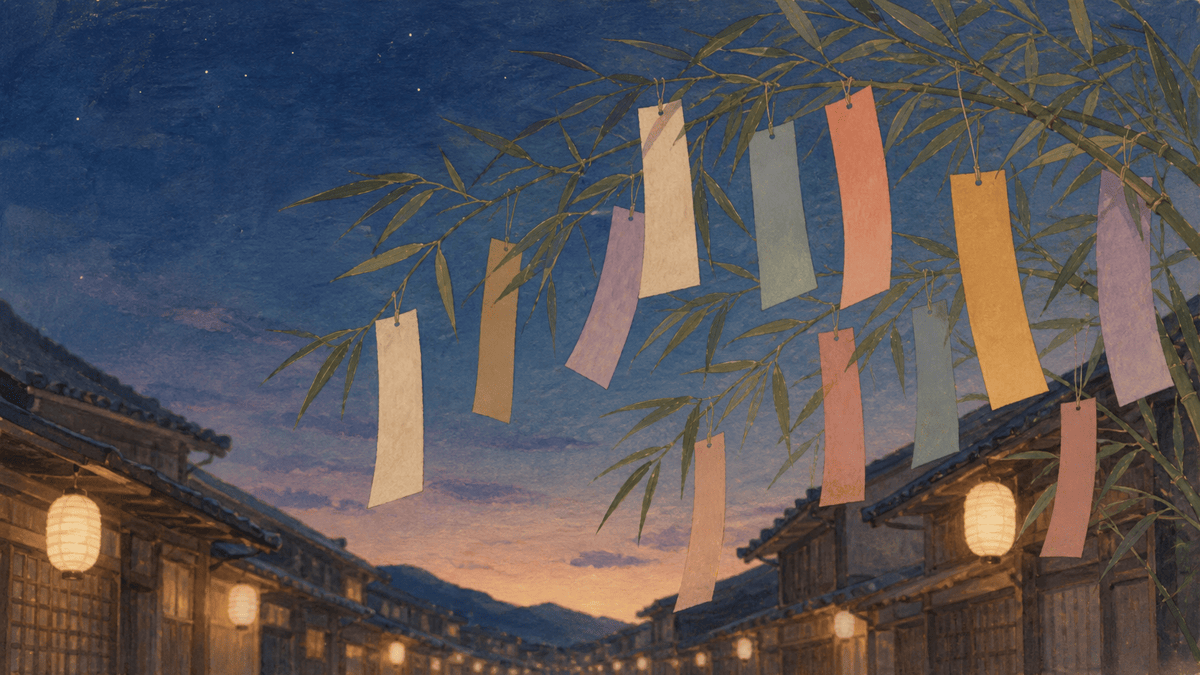
Japan's Tanabata is no longer on a lunar calendar at all. In November 1872 the Meiji government announced the switch to the solar Gregorian calendar, and from 1873 the solar calendar replaced the lunisolar one. There was almost no preparation: what would have been 3 December 1872 became 1 January 1873 overnight, and the country was thrown into confusion. Tanabata moved with the calendar, which is why most of Japan now keeps it on 7 July, with some regions around 7 August. The content diverged as well. People write wishes on coloured strips of paper, tanzaku, and hang them on bamboo — the legend of Altair and Vega meeting once a year survives, but neither dexterity nor courtship is the theme; the wish itself is. Institutionally the day has no standing: Article 2 of the Act on National Holidays of 1948 enumerates sixteen public holidays, from New Year's Day and Coming of Age Day through to Labour Thanksgiving Day, and Tanabata is not one of them. Where it is kept in August it coincides with Obon, when ancestors are welcomed home, so the two are often run together.
- August 6, 2027– August 8, 2027Local date
How does Japan mark Tanabata and Qixi? · 仙台七夕まつり
Sendai moved the festival a month later instead. The Sendai Tanabata Festival runs on 6 to 8 August every year — in 2026 that is Thursday the 6th through Saturday the 8th. This is tsukiokure, "a month behind": rather than following the Gregorian 7 July, the city keeps the seasonal position the old seventh lunar month used to hold. A fireworks display opens the run on the evening of 5 August; the 2026 edition was the 57th, with about 16,000 shells. In scale, bamboo poles over ten metres long are raised from the front of Sendai Station through the surrounding arcades, more than three thousand across the city, and the festival stands with Aomori's Nebuta and Akita's Kantō as one of the three great summer festivals of the Tōhoku region. Historically it took root after Date Masamune (1567–1636) built Sendai at the start of the seventeenth century and promoted it, giving the festival more than four hundred years of history; it was interrupted by war, and the city marks the 2026 edition as the eightieth since the post-war revival. The decorations carry their own vocabulary: alongside tanzaku there are folded cranes, kimono, purses and streamers resembling fishing nets or woven baskets, each standing for something — the purse for wealth and prosperity, the net for a good catch and a good harvest.
- August 8, 2027Local date
How does China mark Tanabata and Qixi?七夕节
China recognises Qixi, but as heritage rather than as a holiday. In 2006 the State Council published the first national list of intangible cultural heritage — 518 items, of which seventy fall under folk custom. The Qixi Festival is entry 452, submitted by the Ministry of Culture, sitting among Lunar New Year at 449, Qingming at 450, Duanwu at 451, Mid-Autumn at 453 and Double Ninth at 454. Open the Measures on Holidays for National Annual Festivals and Commemorative Days, as amended by State Council Order No. 795 of 2024, and the picture reverses: the days off for all citizens are New Year's Day, Lunar New Year, Qingming, Labour Day, Duanwu, Mid-Autumn and National Day; partial days go to Women's Day, Youth Day, Children's Day and Army Day; and Article 5 names a further batch — 7 February, 30 May, 7 July, 3 September, 18 September, Teachers' Day, Nurses' Day, Journalists' Day, Arbor Day — as days that carry no time off. Qixi does not appear even on that list of explicitly non-holidays. The trace it leaves is somewhere else. Couples like to register their marriages on Qixi, which turns "will the registry be open" into an annual question. In 2024 Qixi fell on Saturday 10 August; on 5 August the Ministry of Civil Affairs' social affairs department answered a public query by saying that local civil affairs bureaus are encouraged to meet demand and open, but that no binding requirement had been set. Because the day is not a statutory holiday, the answer is decided locally, one bureau at a time. Qixi falls on a Sunday in 2027 and a Saturday in 2028, so the question comes round twice more.
- August 8, 2027Local date
How does Taiwan mark Tanabata and Qixi? · 七夕
Taiwan keeps Qixi on the lunar date: 19 August in 2026 (a Wednesday), 8 August in 2027 (a Sunday), 26 August in 2028 (a Saturday). Its legal position is easy to check and slightly startling. Article 5 of the Act on Commemorative Days and Holidays lists nine folk festivals — Lunar New Year, the Lantern Festival, Qingming, Duanwu, the Zhongyuan Festival, Mid-Autumn, Double Ninth, Lunar New Year's Eve and the indigenous seasonal rites — and Qixi is not among them. Article 6 then closes the door: festivals outside the enumerated set carry no day off. So Qixi is not even a named day that happens to be worked; it is unnamed. Eight days later in the same lunar month the Zhongyuan Festival does get named, and still gets no holiday. The National Immigration Agency's portal for new residents records the day as "commonly called the Chinese Valentine's Day, set on the seventh day of the seventh lunar month", and preserves two older names alongside it: the Begging for Skill Festival, from the practice of asking the Weaver Girl for dexterity, and the Daughters' Festival, because those who took part were mostly women of the household. Shops and restaurants sell the first name; the other two survive in the record.
- August 8, 2027Local date
How does Taiwan mark Tanabata and Qixi? · 做十六歲
The same date carries something else entirely in Tainan. The seventh day of the seventh lunar month is the birthday of the Seven Mothers, Qiniangma, held to guard children from birth until sixteen. In the year a child turns sixteen the family removes the old coin and red thread worn since infancy, prepares spirit money, incense, candles and a paper pavilion called the qiniangma ting, and performs the coming-of-sixteen rite. Kailong Temple in Tainan's West Central District, founded in 1732 under the Yongzheng emperor and dedicated to the Seven Star Ladies, is where it is most visible: on 22 August 2023 more than a hundred teenagers came in traditional dress or scholar's robes, made their offerings, passed beneath the altar table bearing the paper pavilion, and hung wish cards on a bridge. The city of Tainan has registered the custom as a municipal folk heritage item, which gives it a legal identity rather than only a customary one, and the city's Cultural Heritage Management Office has run an annual demonstration since 2012 — by 2019 the eighth of them — inviting host families to perform the full sequence inside their own homes, and working with the Shih clan ancestral hall and the Taiwan Fund for Children and Families so that teenagers from low-income households can go through it too. One date, two unrelated things: an evening out at one end, a family walking a child into adulthood at the other.
- Not observed hereLocal date
Does Brazil have Tanabata and Qixi?
Brazil gives the day no place in law, but it does hold the festival - and here the date has come loose from its calendar altogether. Sao Paulo's Liberdade district has run the Tanabata Matsuri, the Festival of the Stars, since 1979, organised by the Liberdade cultural and welfare association (ACAL) and the Miyagi prefectural association of Brazil, with support from the Se subprefecture; the city's own description calls it the largest Japanese street event in the world. The Praca da Liberdade-Japao and the streets around it are hung with eighty giant bamboos carrying tanzaku in six colours - white for peace, yellow for money, green for hope, red for passion and gratitude, pink for love, blue for health and the protection of the heavens - burnt at the end so the wishes reach Vega and Altair. Scale and dates are both on record: the 29th edition, 7-8 July 2007, drew an estimated 150,000 people; the 32nd ran 24-25 July 2010; the 41st, 13-14 July 2019, with around 800 volunteer dancers from member associations. And that is the point for this page: in Brazil the date detached completely. Not the seventh of the seventh, and not a fixed day at all - a July weekend the organisers choose each year.
- Not observed hereLocal date
Does Indonesia have Tanabata and Qixi?
Indonesia's 2026 holidays were set by a joint decree (SKB) of the ministers of religious affairs, manpower and administrative reform: seventeen national holidays plus eight days of collective leave, twenty-five days in all. The list is worth reading for more than the fact that Qixi is missing from it. 17 February is Tahun Baru Imlek 2577 Kongzili - Chinese New Year - with a collective leave day added on 16 February. The Chinese lunisolar calendar is in Indonesia's national holiday decree; it is in it for exactly one day. The other sixteen run on the Gregorian calendar (New Year, Labour Day, Independence Day, Christmas), the Islamic calendar (Isra Mikraj, Idul Fitri, Idul Adha, the Islamic New Year, the Prophet's birthday), the Balinese Saka calendar (Nyepi), the Buddhist calendar (Waisak) and the Christian Easter cycle (Good Friday, Easter, Ascension). So the Indonesian holiday system runs half a dozen calendars at once, the Chinese one among them - its recognition simply stops at New Year and does not extend to the seventh day of the seventh month.
- Not observed hereLocal date
Does India have Tanabata and Qixi?
India's national holiday list for 2026 runs to seventeen entries: Republic Day, Holi, Id-ul-Fitr, Ram Navami, Mahavir Jayanti, Good Friday, Buddha Purnima, Id-ul-Zuha, Muharram, Independence Day, Milad-un-Nabi, Janmashtami, Gandhi Jayanti, Dussehra, Diwali, Guru Nanak's Birthday and Christmas. Qixi is not on it - but the interesting part is not the absence, it is the reason for it. Holi, Ram Navami, Janmashtami, Dussehra and Diwali all move from year to year because they run on India's own lunisolar reckoning, and the four Islamic entries move on the Hijri calendar. India's holiday system handles moving lunar dates perfectly well; it simply runs different calendars. The Chinese lunisolar calendar that Qixi hangs on does not operate here at all, so the seventh day of the seventh month points at a different month under a different arithmetic.
- Not observed hereLocal date
Does United States have Tanabata and Qixi?
There is no federal day for this in the United States, and structurally there could not be. Title 5, section 6103 of the U.S. Code fixes eleven legal public holidays: New Year's Day; the birthday of Martin Luther King, Jr. (third Monday in January); Washington's Birthday (third Monday in February); Memorial Day (last Monday in May); Juneteenth (19 June); Independence Day (4 July); Labor Day (first Monday in September); Columbus Day (second Monday in October); Veterans Day (11 November); Thanksgiving (fourth Thursday in November); and Christmas (25 December). Every entry is written one of two ways - a fixed Gregorian date, or the nth weekday of a named month. Not one hangs on a lunisolar calendar, and there is no federal mechanism for converting a lunisolar date into a holiday: the list is statute, and adding a day takes an act of Congress. So the seventh night of the seventh month has no institutional position in the United States at all. It exists where communities keep it, and that leaves no federal paper trail.
Sources and dates
Dates follow local time zones, calendars, and official notices. Check the source when a date is estimated or locally variable.
- ndl.go.jp ↗
- tainan.gov.tw/news_content.aspx ↗
- gov.cn/content_334718.htm ↗
- mzt.guizhou.gov.cn ↗
- mlit.go.jp ↗
- city.hiratsuka.kanagawa.jp/page35_00241… ↗
- nit.immigration.gov.tw ↗
- gov.cn/content_6989774.html ↗
- gov-online.go.jp ↗
- tainan.gov.tw/News_Content.aspx ↗
- city.hiratsuka.kanagawa.jp/page02_e0000… ↗
- tmach-culture.tainan.gov.tw ↗
- hko.gov.hk/T2026c.txt ↗
- hko.gov.hk/T2028c.txt ↗
- hko.gov.hk/T2027c.txt ↗
- www8.cao.go.jp ↗
- city.sendai.jp ↗
- law.moj.gov.tw ↗
- prefeitura.sp.gov.br/96377 ↗
- prefeitura.sp.gov.br/116929 ↗
- prefeitura.sp.gov.br/131317 ↗
- kemnaker.go.id ↗
- incredibleindia.gov.in ↗
- govinfo.gov ↗