How does Japan mark Tanabata and Qixi?
湘南ひらつか七夕まつり
- Local date
- July 2, 2027–July 4, 2027
- When is it?
- Three days from the first Friday in July, fixed each year by the organising committee.
Hiratsuka in Kanagawa Prefecture supplies a third timing. The Shonan Hiratsuka Tanabata Festival runs in early July — neither the 7th nor August: the 74th edition ran 3 to 5 July 2026, a Friday to a Sunday, after the 73rd drew 1.15 million visitors over its three days. The city's press release of 23 April 2026 sets out the detail: eighty decorations along the Shonan Star Mall, twenty-six of them made by residents, seventeen more along Beniya Pearl Road, around a hundred large pieces in the shopping streets by the station; closing time on the first two days extended by thirty minutes to 8.30 p.m., and 7 p.m. on the last day; the thousand-strong Tanabata dance parade rerouted for heat safety, with a "Tanabata COOL" scheme asking shopfront traders to help keep visitors cool and mist fans installed along the decorated streets. The same release announces the following year in advance: 2 to 4 July 2027. Put the three side by side and the point is visible inside a single country — 7 July, 6–8 August, and the first weekend of July, and not one of them is the seventh day of the seventh lunar month.
七夕(たなばた)
- Local date
- July 7, 2027
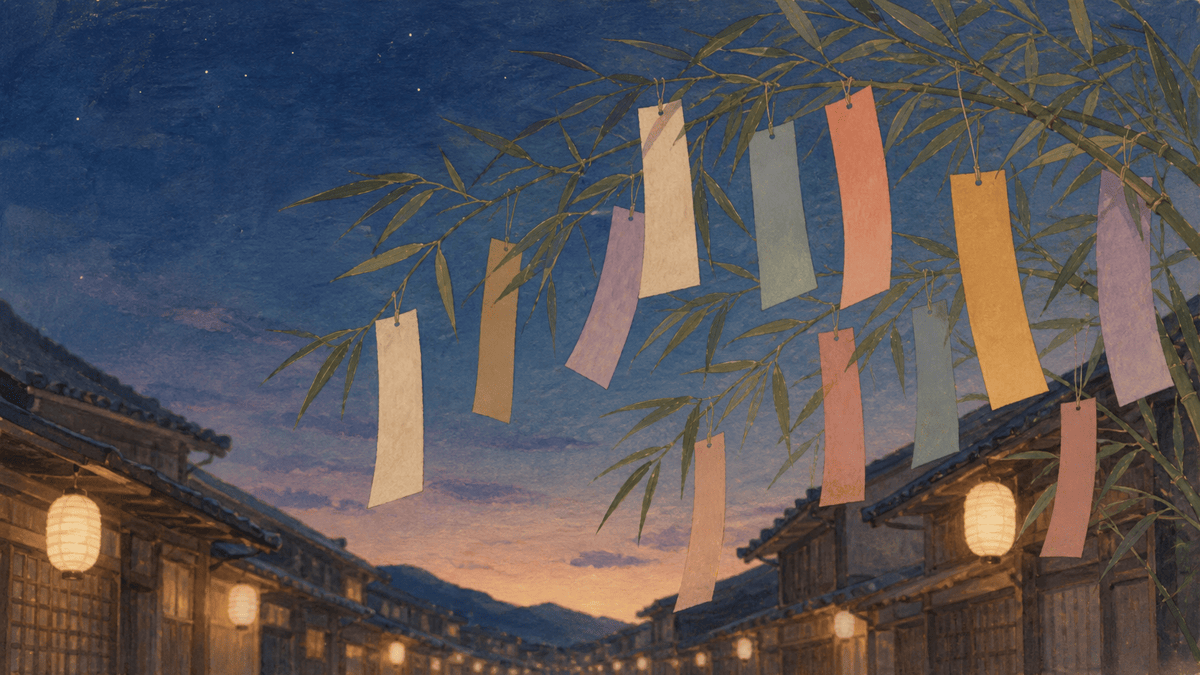
Japan's Tanabata is no longer on a lunar calendar at all. In November 1872 the Meiji government announced the switch to the solar Gregorian calendar, and from 1873 the solar calendar replaced the lunisolar one. There was almost no preparation: what would have been 3 December 1872 became 1 January 1873 overnight, and the country was thrown into confusion. Tanabata moved with the calendar, which is why most of Japan now keeps it on 7 July, with some regions around 7 August. The content diverged as well. People write wishes on coloured strips of paper, tanzaku, and hang them on bamboo — the legend of Altair and Vega meeting once a year survives, but neither dexterity nor courtship is the theme; the wish itself is. Institutionally the day has no standing: Article 2 of the Act on National Holidays of 1948 enumerates sixteen public holidays, from New Year's Day and Coming of Age Day through to Labour Thanksgiving Day, and Tanabata is not one of them. Where it is kept in August it coincides with Obon, when ancestors are welcomed home, so the two are often run together.
仙台七夕まつり
- Local date
- August 6, 2027–August 8, 2027
Sendai moved the festival a month later instead. The Sendai Tanabata Festival runs on 6 to 8 August every year — in 2026 that is Thursday the 6th through Saturday the 8th. This is tsukiokure, "a month behind": rather than following the Gregorian 7 July, the city keeps the seasonal position the old seventh lunar month used to hold. A fireworks display opens the run on the evening of 5 August; the 2026 edition was the 57th, with about 16,000 shells. In scale, bamboo poles over ten metres long are raised from the front of Sendai Station through the surrounding arcades, more than three thousand across the city, and the festival stands with Aomori's Nebuta and Akita's Kantō as one of the three great summer festivals of the Tōhoku region. Historically it took root after Date Masamune (1567–1636) built Sendai at the start of the seventeenth century and promoted it, giving the festival more than four hundred years of history; it was interrupted by war, and the city marks the 2026 edition as the eightieth since the post-war revival. The decorations carry their own vocabulary: alongside tanzaku there are folded cranes, kimono, purses and streamers resembling fishing nets or woven baskets, each standing for something — the purse for wealth and prosperity, the net for a good catch and a good harvest.
What is this topic?
One legend about a weaver and a herdsman, one date in the seventh lunar month, and three societies that made three different festivals out of it.
Taiwan keeps it on the lunar calendar and stacks two things on the same day — a couples' evening and a coming-of-age rite in Tainan.
China registered it as national intangible heritage but left it off even the list of days explicitly named as non-holidays.
Japan moved it onto 7 July when the country switched calendars in 1873, while Sendai pushed it a month later to 6–8 August.
This page compares where the day sits in law, who gets time off, and what each place kept of the story.
🗳️ What about you?
If a Tanabata- or Qixi-like day existed where you live, how would you spend it?
Live answers aren't available right now. Read the topic below.
Sources and dates
- city.hiratsuka.kanagawa.jp/page02_e0000… ↗
- city.hiratsuka.kanagawa.jp/page35_00241… ↗
- ndl.go.jp ↗
- www8.cao.go.jp ↗
- gov-online.go.jp ↗
- city.sendai.jp ↗
Dates follow local time zones, calendars, and official notices. Check the source when a date is estimated or locally variable.