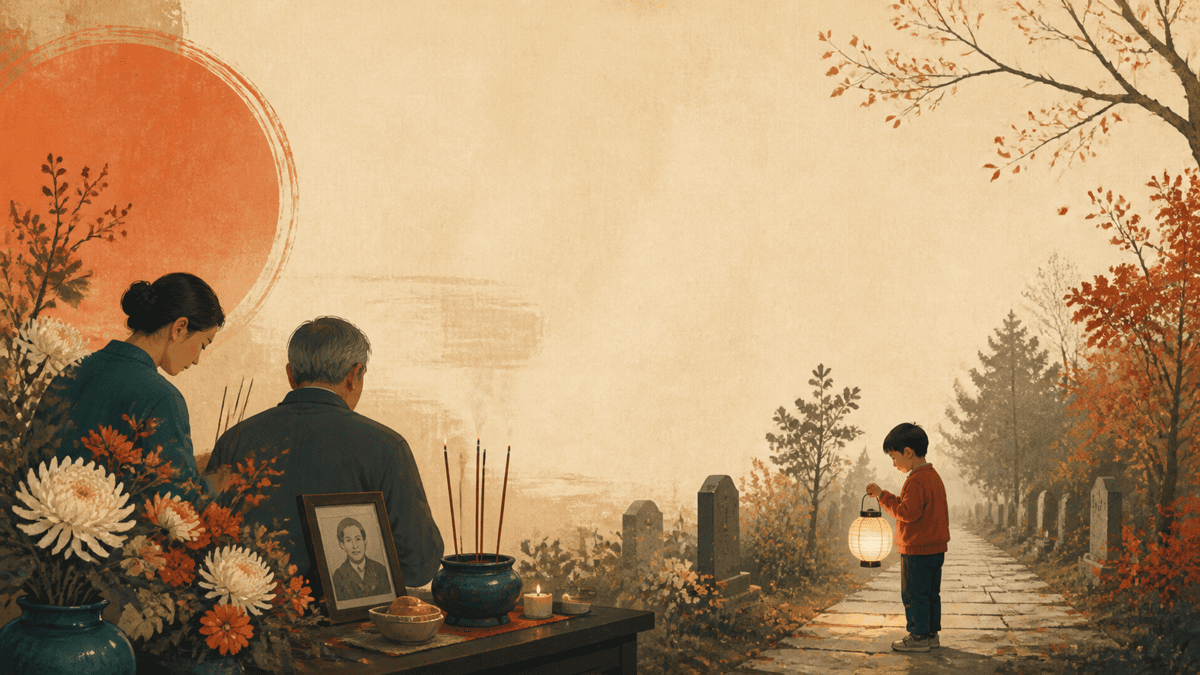
Ghosts, Ancestors, and Remembrance
How the world celebratesIt does not assume that every household or community follows the same practice.
Quick answers
| Place | When is it? | How the date is set |
|---|---|---|
| United States | Not observed here | Not on the official list |
| Brazil | November 2, 2026 | — |
| China · 清明节 | April 5, 2027 | Around April 4 to April 6 in the Gregorian calendar |
| Taiwan · 清明節 | April 5, 2027 | Around the 15th day after the vernal equinox, with the date varying slightly each year |
| Taiwan · 農曆七月/中元普渡 | August 2, 2027 – August 31, 2027Local dates may differ | In the seventh lunar month; the date of local Pudu (Ghost Festival) rites varies by community |
| Japan | August 13, 2027 – August 16, 2027Local dates may differ | In most regions, August 13 to August 16; local dates may vary |
| China · 中元节 | August 16, 2027 | Around the 15th day of the seventh lunar month; practices vary by locality |
| Indonesia | Not observed here | Not on the official list |
| India | Not observed here | Not on the official list |
World questions on this topic →
🗳️ What about you?
Asked by the 🇺🇸 English community
For the 🇮🇩 Bahasa Indonesia community
How many times a year do you visit the family graves?
Live answers aren't available right now. Read the topic below.
Say what is wrong and what is correct — a source link helps.
Near you
Nothing here yet.
Events
Nothing here yet.
Now
People are talking about this
Live discussion isn't available right now
Read the topic and check back later.
How the world celebrates
- November 2, 2026Local date
How does Brazil mark Ghosts, Ancestors, and Remembrance?Dia de Finados
Brazil's Day of the Dead is 2 November, a national holiday under Law 662 as amended in 2002. Families go to the cemetery to lay flowers, light candles and tidy the grave, while churches hold memorial Masses. It runs on from All Saints' Day on 1 November, but the day off is the second. November is late spring south of the equator, so tending graves does not carry the bleak seasonal feeling it has in the northern hemisphere.
- April 5, 2027Local date
How does China mark Ghosts, Ancestors, and Remembrance? · 清明节
Qingming in mainland China is one of the days off for all citizens under the national holiday regulation, falling between 4 and 6 April. Tending the grave, laying flowers and adding earth to the mound are the core acts, and in recent years localities have promoted online remembrance and flowers in place of burning. It is also one of the twenty-four solar terms, so Qingming is at once a day of offerings and a marker in the farming year — the spring outing and the grave visit sit on the same day.
- April 5, 2027Local date
How does Taiwan mark Ghosts, Ancestors, and Remembrance? · 清明節
In Taiwan, Qingming brings grave visits, cleaning, and family rites. Some people travel home early; others adapt the day to city life, family schedules, or personal belief.
- August 2, 2027– August 31, 2027Local dateLocal dates may differ
How does Taiwan mark Ghosts, Ancestors, and Remembrance? · 農曆七月/中元普渡
Taiwan's Ghost Month includes offerings, household tables, taboos, and in some places large events such as Qianggu. Families, religions, and neighbourhoods do not share one list of things to avoid.
- August 13, 2027– August 16, 2027Local dateLocal dates may differ
How does Japan mark Ghosts, Ancestors, and Remembrance?お盆
Obon is a time to welcome and see off ancestors. Returning home, tending graves, and local Bon odori are connected in some places, while dates and customs differ across Japan. Obon is not a statutory holiday, yet it is the year's most visible national pause: most firms set their own closure in mid-August, so the homeward traffic and the fares have a fixed peak. The welcome fire and the send-off fire at the door frame the whole thing as a round trip — a fire to bring them back, another a few days later to see them off, with the Bon dance filling the days in between.
- August 16, 2027Local date
How does China mark Ghosts, Ancestors, and Remembrance? · 中元节
Zhongyuan practices in China may include ancestor offerings, communal rites, incense, and local ceremonies. Like Ghost Month, it brings the dead and wandering spirits into view, but local religions and families observe it differently.
- Not observed hereLocal date
Does Indonesia have Ghosts, Ancestors, and Remembrance?
Indonesia has no Qingming or Zhongyuan, but Java has Nyadran: going to the ancestral graves during the month of Ruwah, before Ramadan begins. The word comes from the Sanskrit sraddha, faith. The sequence is fixed — clean the graves, then pray together, then close with kembul bujono, everyone eating one meal side by side. It began in pre-Islamic belief and later merged with Javanese Islamic practice. Like Qingming it is grave-tending, but it aligns not with a particular date so much as with the fact that fasting starts next month.
- Not observed hereLocal date
Does India have Ghosts, Ancestors, and Remembrance?
India has no Qingming or Zhongyuan, but it has Pitru Paksha: a stretch of sixteen lunar days for the ancestors, running from the full moon of Bhadrapada to the new moon of Ashwin, called Mahalaya. What is done in that span is Shraddh, Tarpan and Pind Daan — offerings of water and food to the departed, and the asking of forgiveness; Gaya in Bihar draws a large annual gathering for exactly this. Unlike Qingming, which is a single day, the unit here is half a month; and unlike the Zhongyuan offering to wandering spirits, the recipients are one's own forebears only.
- Not observed hereLocal date
Does United States have Ghosts, Ancestors, and Remembrance?
The United States has no Qingming and no national day for the dead. Not one of the eleven federal holidays in 5 U.S.C. §6103 is given to ancestors; the nearest, Memorial Day, is for those killed in war, not for one's own forebears. What comes closest belongs to particular communities: Mexican American families build an ofrenda for Día de los Muertos on 1 and 2 November, and at César E. Chávez National Monument in California the altar first raised for Chávez in 1993 is rebuilt each year by community members bringing photographs of their own dead. There are places for remembering ancestors here, but no day for it.
Sources and dates
Dates follow local time zones, calendars, and official notices. Check the source when a date is estimated or locally variable.