How does China mark Dragon Boat Festival?
端午节
- Local date
- June 9, 2027
- When is it?
- The 5th day of the 5th lunar month; the Gregorian calendar date varies each year
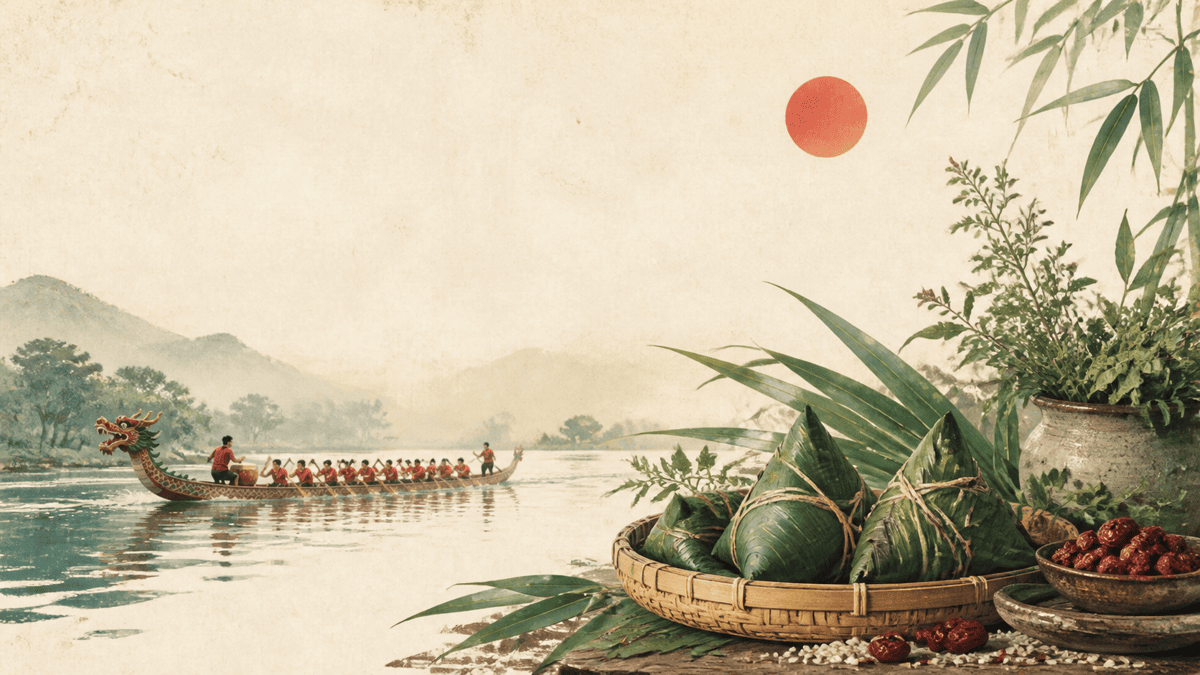
Mainland China lists Duanwu among the days off for all citizens in the national holiday regulation. It was published in the very first batch of national intangible cultural heritage in 2006 under the code X-3, and is now administered by the Ministry of Culture and Tourism. The listing names commemorating historical figures, dragon boat racing, eating zongzi, and a whole set of practices for warding off the 'five poisons': paper-cut charms, hanging mugwort and calamus, scented pouches, and herbal baths. In the register the festival is a plural set of customs, not a single image.
端午节(蒋村龙舟胜会)
- Local date
- June 9, 2027
- When is it?
- On the 5th day of the 5th lunar month, Jiangcun, Xihu District, Hangzhou City, Zhejiang Province
A second dragon boat custom is listed separately under the same code X-3: the Jiangcun Dragon Boat Gathering in the Xihu district of Hangzhou, Zhejiang, published in the third batch in 2011. Residents organise it themselves on the day of Duanwu, and the story told is that the Qianlong Emperor, travelling south, found the racing at Jiangcun as lively as a market fair and bestowed the name 'Dragon Boat Gathering'. One to two hundred boats converge at Shentankou in the Xixi wetland, perform along a set route, and finish with a full turn in the centre; households wrap zongzi, hang mugwort and calamus, and eat the 'five yellows', with each village then dining together afterwards.
罗店划龙船习俗(上海)
- Local date
- June 9, 2027
- When is it?
- Around the 5th day of the 5th lunar month, according to local arrangements
Within the same festival, the dragon boat custom of Luodian in Shanghai is listed as a national intangible heritage item in its own right. That tells you something: dragon boating is not one nationally uniform race but a set of local traditions with their own rules, hull shapes, and ceremonies, some of which are judged worth protecting separately. Looking only at the nationwide picture of 'how Duanwu is kept' misses this layer entirely.
What is this topic?
The fifth day of the fifth lunar month is a public holiday in both Taiwan and mainland China, while Japan moved the same 'fifth of the fifth' onto the Gregorian calendar and turned it into a statutory children's day.
This page compares four things: who gets the day off, where the rice dumplings and the boats sit, how far local versions are listed as heritage in their own right, and how the day was re-defined in Japan as respecting a child's character while also thanking the mother.
🗳️ What about you?
Asked by the 🇮🇩 Bahasa Indonesia community
For the 🇺🇸 English community
Is there a boat race where you live? When is it held?
Live answers aren't available right now. Read the topic below.
Sources and dates
- gov.cn ↗
- ihchina.cn/20215.html ↗
- hko.gov.hk/2026.pdf ↗
- ihchina.cn/20209.html ↗
- ihchina.cn/20208.html ↗
- hko.gov.hk/2027.pdf ↗
Dates follow local time zones, calendars, and official notices. Check the source when a date is estimated or locally variable.