Topic: Mid-Autumn and Moon Viewing
How does Japan mark Mid-Autumn and Moon Viewing?
十三夜(後の月)
- Local date
- October 23, 2026
- When is it?
- The night of the 13th day of the 9th month in the lunar calendar. A moon-viewing paired with the Mid-Autumn Moon (15th day of the 8th month in the lunar calendar)
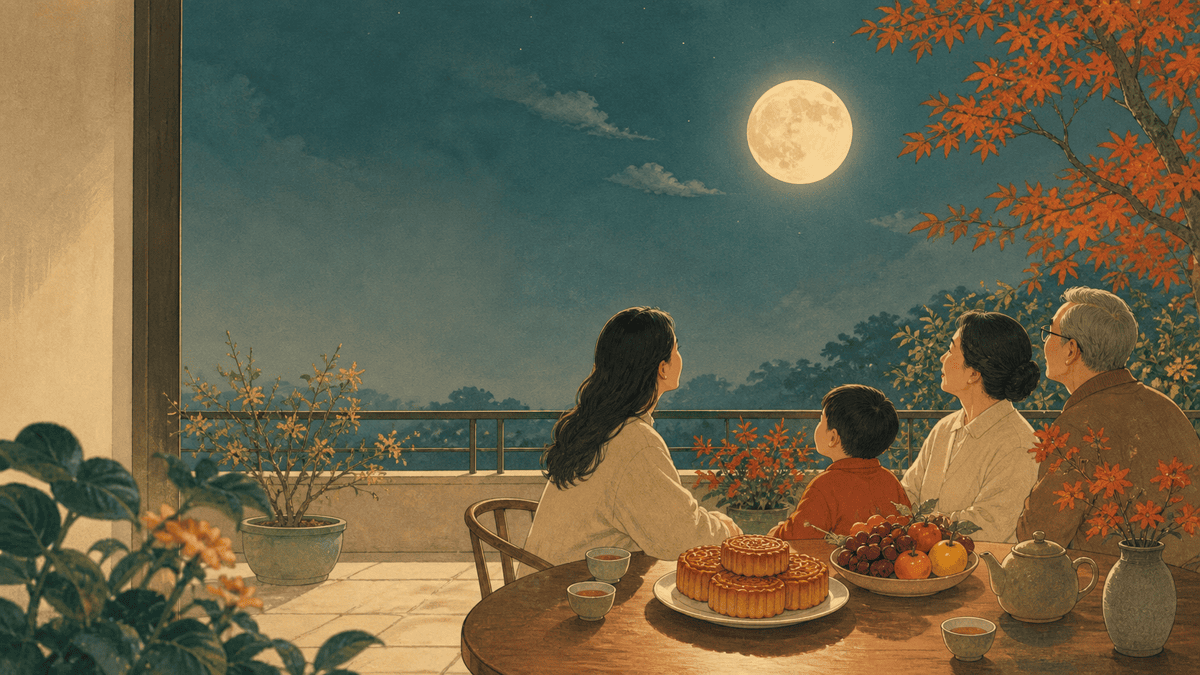
Moon viewing in Japan does not happen only once: after the fifteenth night of mid-autumn comes Jusanya, the thirteenth night of the ninth lunar month, also called the later moon, forming a pair with the first. The National Astronomical Observatory's calendar wiki treats it in the same set of entries as the harvest moon. Traditionally, seeing only one of the two was called katami-zuki, a 'half viewing', and regarded as incomplete — so in Japan moon viewing is something that only counts when done twice.
中秋の名月(十五夜)
- Local date
- September 15, 2027
- When is it?
- The night corresponding to the 15th day of the eighth month in the lunar calendar. The date often differs from the actual full moon
Japan does not close for Mid-Autumn. It is called Jugoya or Chushu no Meigetsu, the night of the fifteenth day of the eighth month in the old calendar, marked with pampas grass and rice dumplings set out for the moon. The National Astronomical Observatory is explicit about something widely misunderstood: the harvest moon is not necessarily the full moon. The interval from new moon to full moon varies between about 13.9 and 15.6 days, because the Moon's orbit is elliptical and it travels faster when nearer the Earth. In 2026 the harvest moon falls on 25 September while the full moon comes two days later on the 27th; the next time the two land on the same date is 2030. Moon-viewing in Japan is not a single occasion: after the fifteenth night in autumn comes the thirteenth night about a month later, and the two are treated as a pair. Seeing one and missing the other was called the one-sided moon and held to be unlucky — so the unit of the festival here is not one evening but two, a month apart. What is set out is moon-viewing dumplings and pampas grass, the grass standing in for rice ears because the crop is not yet in when the moon is watched.
What is this topic?
Around the same full moon, four different observances: Taiwan and mainland China take the day off, eat mooncakes, and gather as a family; the Korean-ethnic community of Yanbian in China keeps it as Chuseok, where tomb-sweeping comes first; and Japan does not close at all, treating it as an astronomical and seasonal night — where the national observatory is explicit that the 'harvest moon' is often not that night's full moon.
🗳️ What about you?
Asked by the 🇯🇵 日本語 community
Do you celebrate the harvest moon? How do you usually spend it?
Live answers aren't available right now. Read the topic below.
Sources and dates
- eco.mtk.nao.ac.jp/C3E6BDA9A4CECCBEB7EEA4C8A4CF2FBDBDBBB0CCEB.html ↗
- nao.ac.jp ↗
- eco.mtk.nao.ac.jp/C3E6BDA9A4CECCBEB7EEA4C8A4CF2FCCBEB7EEC9ACA4BAA4B7A4E2CBFEB7EEA4CAA4E9A4BA.html ↗
- hko.gov.hk ↗
Dates follow local time zones, calendars, and official notices. Check the source when a date is estimated or locally variable.